Greece Country Program
The International Rescue Committee (IRC) Greece works to strengthen prevention, protection, and response to human trafficking by expanding community engagement, supporting victim protection systems, and promoting accountability for perpetrators. Given Greece’s role as a key migration gateway into Europe, IRC’s programs focus on refugees, asylum seekers, and other vulnerable populations at risk of exploitation along migration routes and within the country.
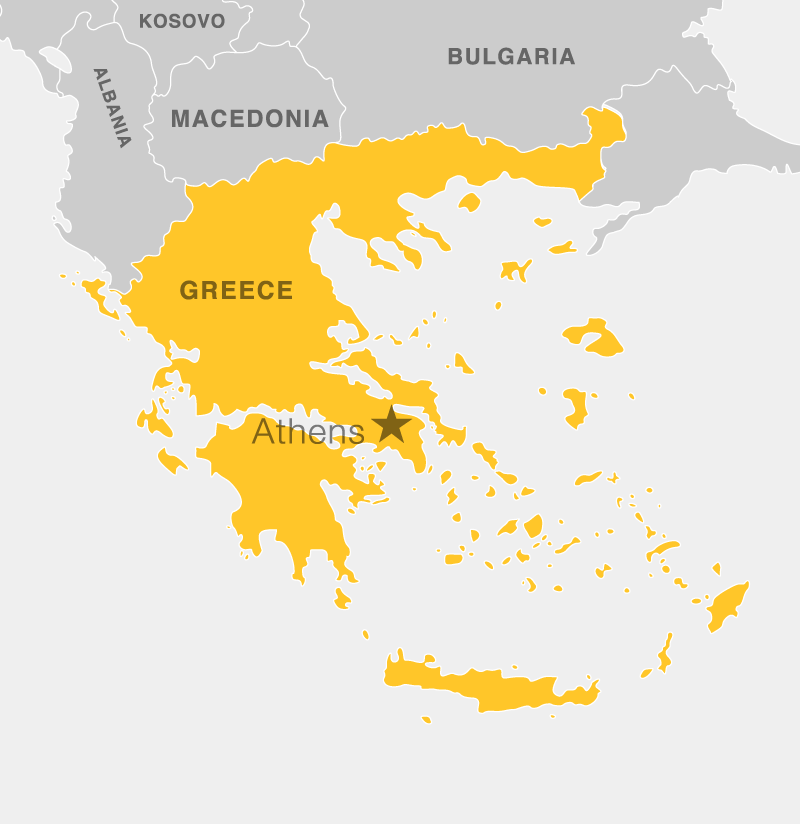
Greece is located at the crossroads of Europe, the Balkans, and West Asia. With a population of around 10 million, it is a member of the European Union and a key gateway between regions. Its strategic location — long land borders, extensive coastline, and hundreds of islands — places the country at the centre of major migration routes.
Over the past decade, Greece has been one of the main entry points into Europe for refugees and migrants fleeing conflict, persecution, and poverty. Many arrive through the Aegean islands or the land border with Türkiye. While the country has developed strong systems to manage migration and protect vulnerable groups, pressures on reception facilities and services continue, and traffickers often exploit these conditions.
Greece functions as a destination, transit, and to a lesser extent source country for human trafficking. Victims are exploited for different purposes both within Greek territory and along migration routes through the country. Individuals at heightened risk include refugees, asylum seekers, unaccompanied and separated children, women and girls, and people experiencing homelessness or economic hardship.
In Greece, trafficking occurs in many forms. Victims arriving from Eastern Europe, Asia, Africa, Latin Americ or from within Greece have been subjected to sexual exploitation, labour exploitation, or forced begging.
Because Greece is a common entry point for migrants into the EU, many newly arriving people—even before exploitation happens—are at heightened risk due to vulnerable status, undocumented arrival, or lack of protection.
The economic crisis, irregular labour markets, lack of controls/oversight by the state and the large informal sector increase vulnerability of exploited persons. Research highlights that exploitation is often linked to migration, labour rights deficits and gender inequalities.
Key issues:
- Difficulty identifying victims among migrant flows.
- Exploitation in sectors such as agriculture, domestic work, hospitality, and on the street.
- Children, especially unaccompanied minors, are particularly at risk of exploitation and trafficking.
Key Actors and Stakeholders
Government Institutions
- National Referral Mechanism (NRM): Central system for identifying and referring victims to protection and services.
- Ministry of Citizen Protection – Hellenic Police Anti-Trafficking Unit: Leads investigations and prosecutions; operates specialised units across the country.
- Ministry of Migration & Asylum: Coordinates protection for migrants and asylum seekers, including vulnerable groups at risk of trafficking.
- Ministry of Labour & Social Affairs: Oversees labour inspections, social protection, and child protection services.
- National Centre for Social Solidarity (EKKA): Manages shelters and coordinates services for vulnerable individuals, including trafficking survivors.
Civil Society and NGOs
- A21 Greece: Operates the national anti-trafficking hotline (1109); provides victim support, awareness, and prevention.
- PRAKSIS: Delivers psychosocial, medical, legal support and outreach programmes for trafficking survivors and vulnerable migrants.
- ARSIS – Association for the Social Support of Youth: Supports children and youth, including unaccompanied minors at risk of exploitation.
- Nea Zoi (New Life): Provides support to individuals in prostitution and survivors of sexual exploitation and trafficking.
- Damaris House / New Life: Recovery programme and safe housing for women survivors of trafficking and their children.
- The Salvation Army – Green Light Project: Supports individuals exploited in prostitution and victims of trafficking in Athens.
International and Regional Partners
- IOM Greece: Provides direct assistance, reintegration support, and capacity-building.
- UNHCR & UNICEF: Support refugees, asylum-seeking children, and unaccompanied minors vulnerable to trafficking.
- OSCE & UNODC: Training, policy support, and coordination with government bodies.
- EU institutions: Provide funding, policy guidance, and monitoring frameworks.
- Council of Europe’s GRETA: Monitors Greece’s compliance with the Anti-Trafficking Convention and issues recommendations.
Coordination Mechanisms
Effective cooperation occurs through the National Referral Mechanism and inter-ministerial working structures that engage government agencies, civil society organisations, and international actors. These coordination bodies support victim identification, protection, information-sharing, and alignment of national anti-trafficking strategies.
Our Work in Greece
IRC Greece works to strengthen trafficking prevention among refugee and migrant communities through information, research, and protection services. Through Refugee.Info Greece, the programme provides multilingual online information explaining human trafficking risks, legal rights, and where victims can seek help. In 2024, IRC Greece conducted a research study in collaboration with Immigration Policy Lab and ETH Zurich, which showed that access to relevant legal information significantly improved participants’ understanding of exploitation under Greek law and increased their confidence in responding to violence. In addition, IRC previously supported unaccompanied children through Semi-Independent Living (SIL) apartments in Athens, where young residents received care from multidisciplinary teams and participated in awareness sessions on trafficking and labour exploitation to strengthen prevention and safety.
Projects Implemented
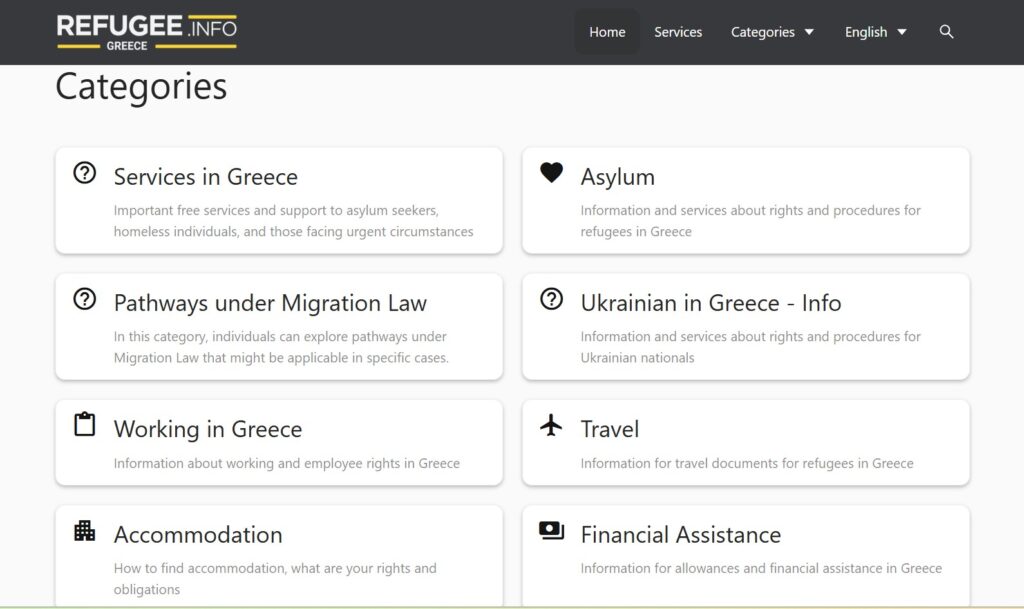
Refugee.Info Greece
Refugee.Info Greece is an award-winning digital support platform that has been operating in Greece since 2015, providing direct, neutral, and reliable information to refugees and migrants. It is available 24/7 in 7 languages through its website and Facebook page where it offers multilingual articles in simple wording, a nationwide interactive service map, and personalized support via social media, responding to individual queries within 48 hours. It covers key topics such as asylum, healthcare, employment, education, housing, and legal residency, helping people navigate essential services and make informed decisions in a complex environment.
Refugee.Info hosts on its website a series of articles on discrimination and human trafficking awareness and prevention in multiple languages. The goal of this section of the website is to inform its users about the risks and dangers of labour exploitation as well as the available services to victims of trafficking and exploitation in Greece. These articles are maintained and updated, when necessary, by the editorial team of Refugee.Info depending on contextual changes on procedures, legislation and available resources for victims of trafficking in Greece.
- Duration: since 2015
- Partners: Former partners include UNHCR, UNICEF, ACCMR, Mobile Info Team, Immigration Policy Lab
- Geographic focus (national / specific regions) : Greece
- Objectives: To empower asylum seekers and refugees in Greece with accurate, time sensitive and up-to-date information on a range of topics that allows them to exercise their rights and meet their obligations.
- Key results or outcomes(Refugee.InfoGreece articles on human trafficking)
Information on the move – a research project on trafficking prevention through information provision
In 2024 Refugee.Info Greece joined forces with The Immigration Policy Lab (IPL) – ETH Zurich and Stanford University to conduct a research project on anti-trafficking prevention. The research team conducted a randomized field experiment in Greece to assess the impact of legal information on forcibly displaced people utilizing the platforms of Refugee.Info Greece and Mobile Info Team to conduct the study. The study found that providing legal information—either through a generic website or personalized WhatsApp/Facebook messenger chats—improved participants’ knowledge of exploitation under Greek law and increased their confidence in responding to violence.
The IPL study highlights Refugee.Info’s role in countering misinformation, fraud, discrimination, and the risks of exploitation and trafficking. By strengthening access to asylum, legal residency, healthcare, and services, and supporting vulnerable groups such as women, girls, and unaccompanied minors, Refugee.Info contributes significantly to protection and inclusion efforts.
- Duration: Throughout 2024
- Partners: Refugee.Info Greece,
- Geographic focus (national / specific regions): Greece
- Objectives:
Research Hypothesis
The study hypothesized that legal information can empower forcibly displaced people by:
- Increasing their knowledge of exploitation under Greek law.
- Enhancing their confidence to respond to violence.
- Improving broader aspects of well-being and integration.
- It also posited that the mode of information delivery—generic (website-based) vs. personalized (chat-based)—would affect both uptake and impact.
Key Outcomes
- Nearly half of participants didn’t know how to seek help after experiencing violence
- Both information channels increased legal knowledge and confidence in responding to exploitation
- Personalized WhatsApp support proved more effective than the generic website for deepening understanding
- No measurable impact on mental health, service access, or integration during the study period
What Worked:
- Refugee.Info Greece reached more people with multilingual legal information on asylum, rights, and services
- Mobile Info Team’s personalized caseworker support via WhatsApp delivered stronger knowledge gains for those who engaged
- Both platforms successfully raised awareness of exploitation risks and pathways to report abuse
Anti-Trafficking Impact: The study confirms that accessible, trusted legal information helps protect displaced populations—especially women, girls, and unaccompanied minors—from trafficking and exploitation. While information alone doesn’t solve everything, it’s a critical first step, and personalized support shows particular promise for scaling prevention efforts.
- Key results: For more information, see the
Key Achievements
Resources and Key Documents
For any question, contact:
Nikolaos Panagiotopoulos, Refugee.Info Manager,
Email :Nikolaos.Panagiotopoulos@rescue.org
https://greece.refugee.info/en-us
https://www.facebook.com/refugee.info/
Country Overview
Over the past decade, Greece has been one of the main entry points into Europe for refugees and migrants fleeing conflict, persecution, and poverty. Many arrive through the Aegean islands or the land border with Türkiye. While the country has developed strong systems to manage migration and protect vulnerable groups, pressures on reception facilities and services continue, and traffickers often exploit these conditions.
Greece functions as a destination, transit, and to a lesser extent source country for human trafficking. Victims are exploited for different purposes both within Greek territory and along migration routes through the country. Individuals at heightened risk include refugees, asylum seekers, unaccompanied and separated children, women and girls, and people experiencing homelessness or economic hardship.
Quick Facts
-
Population: ~10.4 million
-
TIP Report Ranking (2024): Tier 2
-
Main forms of trafficking: Sexual exploitation, forced labour, forced begging, forced criminality
-
Role in trafficking flows: Destination and transit country, and to a lesser extent a source country